
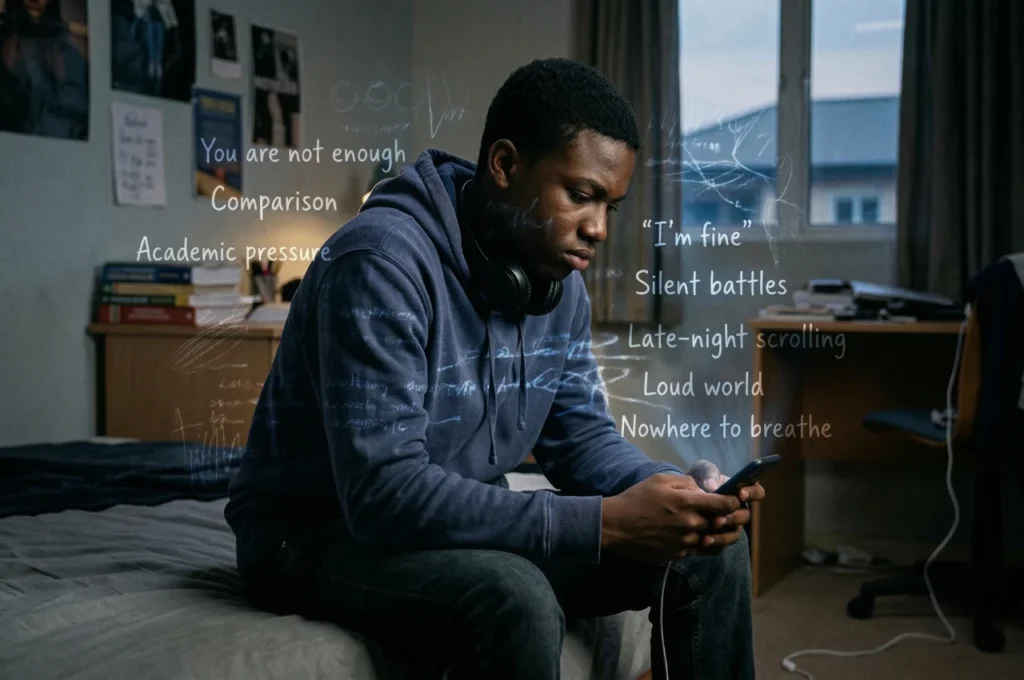
Growing Up in a Loud World: The Silent Battles Today’s Youth Are Fighting
There is a kind of pain many young people carry today that does not always show on the face.
It hides behind forced laughter, delayed replies, late-night scrolling, mood swings, silence at the dinner table, and the words “I’m fine” when everything inside feels like it is falling apart.
Growing up has never been easy. Every generation has had its battles. But growing up in today’s world comes with a different kind of weight. It is louder. Faster. More exposed. More demanding. And for many youths, it feels like there is no place to breathe.
This is the generation expected to figure out life while being watched from every angle. They are expected to be confident, attractive, successful, emotionally strong, socially active, academically excellent, and mentally stable—all at once. They are expected to smile through pressure, perform through pain, and stay silent when nobody seems to understand the storm inside them.
And that is where the danger begins.
Because when a young person’s inner world becomes too heavy, but the outer world keeps demanding more, something eventually breaks.
The Loudness of the Modern World
The world young people are growing up in today is not quiet.
It is full of voices telling them who they should be, what they should look like, how quickly they should succeed, who they should date, how they should dress, how they should behave, and what kind of life is considered “worth it.”
Social media has amplified everything.
A young person can wake up in the morning and, before even speaking to anyone in their home, already feel behind in life. They open their phone and see someone their age getting engaged, someone else starting a business, another traveling, another showing off a “perfect” body, another appearing happy, wanted, loved, and successful. Even when they know some of it is curated, edited, filtered, or exaggerated, it still gets into the heart.
Comparison has become almost automatic.
And comparison is cruel.
It whispers things like:
You are late.
You are not enough.
You are not attractive enough.
You are not smart enough.
You are not doing enough.
Everyone else is moving forward except you.
For many youths, this is not just social pressure. It becomes emotional torment.
A girl begins to hate her body because it does not look like what gets praised online.
A boy begins to question his worth because he does not have money, status, or attention.
A teenager starts feeling ashamed of their skin, their face, their background, their home, their voice, their dreams.
Someone enters a relationship not because they are ready for love, but because they are desperate to feel chosen.
Another stays in a toxic situation because loneliness feels more frightening than pain.
These are not small things. They shape identity. They affect self-esteem. They influence decisions. And slowly, silently, they can crush the spirit of a young person who is still trying to discover who they are.
When Home No Longer Feels Like a Safe Place
As if the outside world is not loud enough, many youths come back home only to meet another kind of pressure.
Sometimes it is not abuse. Sometimes it is not hatred. Sometimes it is simply misunderstanding.
A parent may love their child deeply and still fail to understand what that child is facing. They may look at depression and call it laziness. They may look at anxiety and call it disrespect. They may look at withdrawal and call it bad behavior. They may respond to emotional pain with correction, comparison, warnings, or anger.
And yet, beneath that behavior, the young person may simply be overwhelmed.
Many parents speak from the world they knew. A world where life was hard, yes, but not digitally invasive. A world where there was pressure, yes, but not pressure that followed you into your bedroom, onto your phone, into your friendships, into your self-image, and into your sleep. A world where one could escape and breathe. Today’s youth often cannot.
So when a parent says, “In our days we did not behave like this,” they may not realize that in these days, the emotional landscape has changed dramatically.
When they compare one child to another—“Why can’t you be like so-and-so?”—they may think they are motivating. But many times, what the child hears is:
You are disappointing.
You are not enough as you are.
You must become someone else to be accepted here.
And that pain runs deep.
There is a special kind of loneliness that comes when a young person is surrounded by family but still feels unseen. When they cannot explain what they feel because every attempt becomes an argument. When they are crying for understanding but receiving criticism instead. When they stop talking, not because they have nothing to say, but because they have learned that speaking does not always bring safety.
That silence can become dangerous.
Because pain that cannot be expressed often looks for another outlet.
When Pain Turns Into Pressure, and Pressure Turns Into Escape
Not every young person who struggles will say, “I am depressed.”
Not every young person who is overwhelmed will ask for help.
Not every young person even has the language to explain what they are carrying.
Sometimes the pain comes out through anger.
Sometimes, due to poor grades.
Sometimes through sleeping too much.
Sometimes, through withdrawing from people.
Sometimes through risky behavior.
And sometimes, it comes out through substance use.
This is one of the painful realities of modern youth struggles.
Substance abuse is often judged from the outside as rebellion, irresponsibility, or bad company. But in many cases, there is something deeper beneath it. There is hurt. There is unresolved pressure. There is emotional exhaustion. There is the desperate need to feel numb for a while.
Some young people do not take substances because they are careless.
Some do it because they are tired.
Tired of thinking.
Tired of failing.
Tired of feeling not enough.
Tired of fighting thoughts they cannot explain.
Tired of carrying pain nobody seems to notice.
For some, substances become a way to temporarily silence what is too loud inside.
At the same time, academic pressure continues to weigh heavily on them.
Young people today are told education is the key to survival, success, and respect. While that may be true, the pressure attached to it can become unbearable. Many students are not only studying for grades. They are studying to prove themselves. To avoid disappointing their parents. To escape poverty. To secure a future. To justify sacrifices made for them. To become the “hope” of the family.
That is not a small burden.
So when they fail, even once, it can feel like their whole identity is collapsing.
The world may see one bad grade.
The student may feel shame, fear, panic, and self-hatred.
The world may say, “Work harder.”
The student may already be mentally drowning.
This is why we must stop reducing youth struggles to attitude problems. What looks like laziness may be burnout. What looks like disobedience may be emotional pain. What looks like carelessness may be a cry for help.
Is Parenting Today the Same as Parenting Before?
This is a question many families need to sit with honestly.
The heart of parenting may still be love, guidance, and protection. But the context has changed. The emotional realities have changed. The social environment has changed. The triggers, temptations, pressures, and wounds young people face today are not identical to those of past generations.
That means parenting must also grow.
Not by losing values.
Not by becoming passive.
But by becoming more emotionally aware.
Some parents were raised in systems where authority was everything. Children listened. Parents instructed. Feelings were rarely discussed. Vulnerability was often mistaken for weakness. Silence was sometimes fear, not peace.
But now, many young people do not only need rules. They need relational safety. They need guidance that does not crush them. They need correction that still preserves dignity. They need parents who do not only ask, “What is wrong with you?” but also pause to ask, “What happened to you?”
That shift changes everything.
Because once we stop seeing the young person as the problem and start seeing them as a person in pain, our response becomes softer, wiser, and more healing.
The Power of Silence in Youth Relationships
In many homes, conflict escalates not because people do not care, but because nobody feels heard.
A child speaks emotionally.
A parent reacts defensively.
Voices rise.
Accusations fly.
Doors slam.
Then both sides walk away wounded.
What if, in those moments, silence was used differently?
Not the silence of neglect.
Not the silence of emotional distance.
But the silence of restraint, listening, and presence.
There is power in a parent who chooses not to respond immediately in anger.
There is power in allowing a hurting teenager to speak fully before correcting them.
There is power in sitting with discomfort long enough to understand what is really being said beneath the attitude, beneath the tears, beneath the resistance.
Sometimes a young person does not need an instant lecture.
They need space.
They need their emotions not to be dismissed.
They need someone mature enough not to turn every conversation into a battle.
Silence can de-escalate what words would only inflame.
Sometimes the most healing sentence a parent can say is:
“I am listening.”
Or:
“Help me understand.”
Or even:
“You do not have to explain everything perfectly. I just want to hear you.”
Those words can open doors that force can never open.
Because when a young person feels emotionally safe, they become more likely to trust. More likely to talk. More likely to accept guidance. More likely to heal.
Creating Safe and Confidential Spaces for Young People
If we want young people to open up, we must give them spaces where honesty does not become a weapon used against them later.
A safe environment is not one with zero rules. It is one with emotional safety.
It is a home where a teenager can admit they are struggling without immediately being shamed.
It is a classroom where a student can say they are overwhelmed without being mocked.
It is a counselling room where vulnerability is treated with dignity.
It is a relationship where confidentiality is honored and trust is protected.
Many young people are not refusing support because they do not need it. They are avoiding support because they fear what will happen if they tell the truth.
They fear being judged.
They fear disappointing the people they love.
They fear being controlled instead of understood.
They fear being exposed when they are already fragile.
They fear that their pain will be minimized with phrases like “You are overthinking,” “Others have it worse,” or “Just pray and move on.”
But healing begins where truth is allowed to breathe.
Parents and educators must learn to create spaces where young people do not have to perform strength all the time. Spaces where they can be confused, uncertain, emotional, and still be treated with respect. Spaces where support is not forced, but offered. Spaces where guidance comes with compassion.
Sometimes the greatest gift an adult can give a young person is not a solution, but safety.
Because once safety is present, growth becomes possible.
What Young People Really Need
They need more than advice.
They need adults who are willing to learn the world they are growing up in, instead of constantly dismissing it.
They need parents who can separate discipline from humiliation.
They need educators who understand that performance is affected by mental and emotional health.
They need counsellors, mentors, and safe communities that remind them they are not weak for struggling.
They need to be told that seeking help is not failure.
They need to know that struggling with identity, pressure, rejection, comparison, or emotional pain does not make them broken. It makes them human.
They need room to become.
And above all, they need to know they are worth more than their grades, their appearance, their mistakes, their online image, or other people’s expectations.
A Call to Parents, Educators, and Caregivers
We cannot keep using old language for new wounds.
We cannot keep interpreting emotional distress as rebellion.
We cannot keep asking young people to survive in a world we do not take time to understand.
This generation does not need more shame.
It does not need more comparison.
It does not need louder voices.
It needs compassion.
It needs curiosity.
It needs wiser parenting.
It needs calmer homes.
It needs trusted counsellors.
It needs schools that care about mental health as much as performance.
It needs adults who are willing to listen before they judge.
Because behind many difficult behaviors is not a bad child, but a wounded heart.
Conclusion
Today’s youth are carrying battles many people cannot see.
They are trying to grow in a world that rarely pauses. A world that constantly evaluates, compares, pressures, and exposes them. A world where identity is fragile, rest is scarce, and emotional pain is often hidden behind normal routines.
Some are silently fighting depression.
Some are battling anxiety.
Some are losing themselves in unhealthy coping habits.
Some are desperate to be understood.
Some are one safe conversation away from beginning to heal.
The question is not whether young people are struggling. Many are.
The real question is whether the adults around them are willing to respond differently.
With empathy instead of assumption.
With presence instead of pressure.
With listening instead of constant lecturing.
With safety instead of shame.
Because sometimes healing does not begin with a big solution.
Sometimes it begins with finally being heard.